The definition of depression has been constantly shifting since the ancient Greeks first wrote about it (Crocq, 2000). Hippocrates’s definition of depression included features we now attribute to anxiety. In 1621 Robert Burton’s definition was even more mixed. The confusion of symptoms continued through the 1800’s with such notable investigators as George Miller, Sigmund Freud, Pierre Janet and Emil Kraepelin each deciding on their on unique mix of features. By the 1950s most research and psychiatric literature focused on anxiety with little mention of depression. It wasn’t until the 1960s that the work of psychologists such as Erin Beck and Martin Seligman that depression was again the focus of interest in psychology. At that time, the DSM II characterized it as Depressive Reaction with symptoms that we would recognize in contemporary times. Then, between 1970 and 1990 the pendulum swung the other way with the features of anxiety being largely absorbed into depression. It was during the late 80’s and early 90’s when Prozac, Zoloft and Paxil began to flood the market as an antidote to depression that it become most widely defined as a deficit of the neurotransmitter serotonin.
Today there are over 26 studies that link the gut microbiome to depression (Simpson et al 2021). The gut brain axis is a bi-directional pathway that is involved with a pro inflammatory response that hijacks tyrosine on its way to becoming serotonin (O’Mahoney et al, 2014). As a consequence psychiatric research is viewing some depressions purely as a physical disorder and wondering how much of the rest is psychological in origin. At the same time Wang and Michaelis (2010) investigated stress as the instigator of too much glutamate in the brain that also drives inflammation that damages neurons as well as creates microbiome changes in the gut. It appears that stress creates inflammation in the brain and the gut and it also appears that they are two side of the same coin.
During high stress periods the HPA axis is driven into action at the same time excess vigilance and excitotoxicity occurs in the brain. The drivers behind this process is the amygdala and the central grey area of the brain (Pankseep, 2005). This is the physiological component of anxiety driven by psychophysiological events (LeDoux, 2015). It is the precursor to the depression when chronic hyperarousal drives the body and mind/brain to extreme limits of functioning. Anxiety and depression appears to exist along a continuum in which one begins to morph into the other as a response to psychological and physiological oxidative stress patterns. As the process develops, symptoms of anxiety and depression begin to overlap progressively and are only more associated with one rather than the other on the extreme ends of the spectrum. There is support for this perspective in the psychological and neurofeedback literature
In the 1980s Richard Davidson (1995) began to uncover a correlation between brain waves and depression. He found that depressed subjects tended to have more alpha brain waves on the left than the right side of the brain. In the 1990’s Peter Rosenfeld and Elsa Bahr, who deeply involved in the emerging field of neurofeedback, took note of this and decided to try training the brain of depressed people with neurofeedback so that alpha shifted back to the right side of the brain causing a shift in mood. They published the successful results of their experiment (Baehr et al., 1997) and since that time multiple RCT studies have confirmed their findings. Choi et al (2009) followed with the first RCT study leaving little doubt as to its efficacy. We have come to recognize that depression is a depletion of the system and a natural protection from further engagement with the environment as Davidson has summarized and alpha asymmetry is reliable indicator (Gold et al, 2012).
Parallel with this research was the work of Heller and Engles which replicated evidence that beta in the right hemisphere in particular was a marker for panic and negative rumination and was associated with overarousal and anxiety (Heller et al., 1997) (Engels et al., 2007). By 2014 researchers published the cumulative evidence that activating the right side of the brain created negative emotions and activating the left side induced positive emotions (Solomon et al., 2014). Since that time research by Manella (2017) and Wang (2019) have found that activating the brain with asymmetry training can be effective for relieving symptoms of both anxiety and depression.
During the course of this research activity which took place over two decades many neurofeedback practitioners have used these findings to generate protocols to help their clients manage and overcome depression and anxiety. Using NewMind asymmetry protocols and software we have helped clinicians effectively manage their clients’ anxiety and depression. To do this we had to view depression as functionally intertwined in a precess of anxiety.
In 2017 I published an article based on a presentation at ISNR outlining a novel method for measuring asymmetry with qEEG so that it correlated highly with the Beck Inventories for anxiety and depression and the Interactive Self Inventory (ISI). Additionally, at NewMind we designed software to do asymmetry protocols and watch hemispheric activation in real time. What became clear as a result of my investigation was that the whole hemisphere on both sides was involved with that process. Anxiety increased progressively as the whole right hemisphere progressively was activated. As the right hemisphere began to saturate the left hemisphere began to be progressively dominated by alpha as the symptoms of depression gained momentum.
In 2021 I produced further evidence that as anxiety reached a severe and measurable level of 25 on the ISI anxiety score, depression started to increase and anxiety began to decrease. It was clear depression began to mitigate the effects of anxiety supporting the theory that social withdrawal and depression were biological protective measures against over exposure to stress.
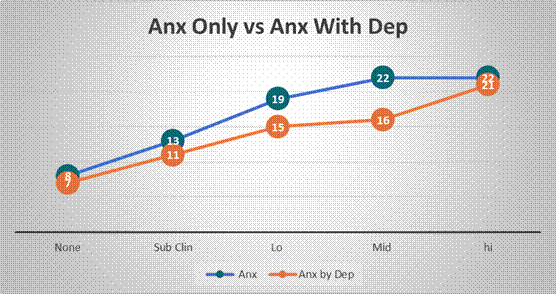
In the chart above the anxiety can be observed to level off at the moderate score of 22 while depressive features begin to increase. In this initial phase of peak symptom mixture the entire right hemisphere is higher than the left in beta except one area which higher in the left hemisphere in alpha and lower in beta. This is the juncture at which the left hemisphere grows in alpha dominance and depression symptoms escalate.
One would think that reducing the anxiety would reduce the depression since depression seemed to be founded upon it. In practice it is not so simple. We found it was necessary with a majority of clients to do alpha asymmetry training first to reduce the depression but then we found that ironically the client increased in anxiety. It seemed clients were being forced as a consequence of the left hemisphere downtraining to again enter into exposure to fear as the protection of depression was removed. It was easily observed that beta amplitude was migrating to the right hemisphere as the alpha diminished in the left hemisphere. As a consequence beta needed to be suppressed in the right hemisphere and increased in the left. The sequence of training was a process of reducing activation in the right hemisphere and increasing it in the left hemisphere. In addition we found it was necessary to begin counseling along with the neurofeedback as well as utilize HRV and breathing to help them manage their anxiety and physiology. At that juncture we were able to reduce the anxiety significantly with neurofeedback as measure by the Beck and ISI.
The brain grows into patterns of anxiety and depression and it has to grow out of them and that involves insight and integration of the experiences that precipitated the anxiety to begin with. Clients need to learn to draw on internal resources to emit novel behaviors which help them adapt to what were once overwhelming challenges. Neurofeedback provides the recovery of the capacity for creative response as well as providing reduced reactivity to allow it to surface. In addition we found that supportive supplementation was necessary. This might involve methyl folate for depression and magnesium for anxiety due to genetic methylation snips creating physiological deficiencies and tendencies toward both. This is consistent with the literature in physiology.
References
Baehr, E., Rosenfeld, J.P., & R. Baehr (1997). The Clinical Use of An Alpha Asymmetry Protocol in the Neurofeedback Treatment of Depression: Two Case Studies. Journal of Neurotherapy, 3, 12-23.
Choi,Sung Won, Sang Eun Chi, Sun Yong Chung, Jong Woo Kim, Chang Yil Ahn, Hyun Taek Kim (2011). Is alpha wave neurofeedback effective with randomized clinical trials in depression? A pilot study. Neuropsychobiology, 63: 43–51.
Craig, A. D. (2005). Forebrain emotional asymmetry: a neuroanatomical basis?,Trends in Cognitive Sciences,Volume 9, Issue 12,566-571,ISSN 1364-6613
Crocq, M. A., & Crocq, L. (2000). From shell shock and war neurosis to posttraumatic stress disorder: A history of psychotraumatology. Dialogues in Clinical Neuroscience, 2(1), 47–55. https://doi.org/10.31887/DCNS.2000.2.1/macrocq
Davidson, R. (1995). Cerebral asymmetry, emotion, and affective style. In: Davidson RJ, Hugdahl K (eds.). Brain Asymmetry 361-387. Cambridge: MIT Press
Engels, A. S., Heller, W., Mohanty, A., Herrington J. D., Banich, M. T., Webb, A. G., Miller, G. A. (2007). Specificity of regional brain activity in anxiety types during emotion processing. Psychophysiology, 44, 352–363
Gold, C., Fachner, J., & Erkkila, J. (2012). Validity and reliability of electroencephalographic frontal alpha asymmetry and frontal midline theta as biomarkers for depression. Scandinavian Journal of Psychology, 1–9. DOI: 10.1111/sjop.12022.
Heller, W., Nitschke, J. B., Etienne, M. A., Miller, G. A. (1997). Patterns of regional brain activity differentiate types of anxiety. Journal of Abnormal Psychology, 106(3), 376–385.
LeDoux, J. (2015). Anxious: Using the brain to understand and treat fear and anxiety. New York, NY: Viking.
Mennella, R., Patron, E., & Palomba, D. (2017). Frontal alpha asymmetry neurofeedback for the reduction of negative affect and anxiety. Behaviour Research and Therapy, 92, 32-40
O’Mahoney, S. M., Clark, G., Borre, Y. E., Dinan, T. G., Cryan, J. F. (2015). Serotonin, tryptophan metabolism and the brain-gut-microbiome axis. Behav Brain Res, 277, 32–48.
doi:10.1016/j.bbr.2014.07.027
Panksepp, Jak (2005). Affective neuroscience: The foundations of human and animal emotions. New York: Oxford University Press
Simpson, C. A., Diaz-Arteche, C., Eliby, D., Schwartz, O. S., Simmons, J. G., & Cowan, C. S. M. (2021). The gut microbiota in anxiety and depression – A systematic review. Clinical psychology review, 83, 101943. https://doi.org/10.1016/j.cpr.2020.101943
Solomon, B., O’Toole, L., Hong, M., & Dennis, T. A. (2014). Negative affectivity and EEG asymmetry interact to predict emotional interference on attention in early school-aged children. Brain and Cognition, 87, 173-180.
Soutar, R. (2017). Asymmetry as a reliable measure of adult anxiety and depression. New Mind Journal. Fall 1-4.
Soutar, R. (2017). Perspective and method for a qEEG based two-channel bi-hemispheric compensatory model of neurofeedback training. In T. Collura & J. Frederick (Eds.), Handbook of clinical QEEG and neurotherapy (pp. 387-403). New York, NY: Routledge
Soutar, Richard (2021). The reciprocal relationship between depression & anxiety: Archival Findings 1. New Mind Journal. Fall 1-5
Wang, X., Michaelis, E. K. (2010). Selective neuronal vulnerability to oxidative stress in the brain. Frontiers in Aging Neuroscience, 12, 1–13.
Wang, S. Y., Lin, I. M., Fan, S. Y., Tsai, Y. C., Yen, C. F., Yeh, Y. C., & Lin, H. C. (2019). The effects of alpha asymmetry and high-beta down-training neurofeedback for patients with the major depressive disorder and anxiety symptoms. Journal of Affective Disorders, 257, 287-296.